University students manage a constant flow of information from lectures, textbooks, research papers, online classes, and group projects. Without an organized system, important ideas can become buried in scattered documents, screenshots, and unfinished notes. Choosing the right digital note-taking method can make it easier to organize coursework, understand complex topics, and prepare for exams.
The digital note taking methods for students are not necessarily the most complicated or feature-rich. They are the methods that help you capture important information, connect ideas, find what you need quickly, and review material regularly.
Digital notes offer several practical advantages. You can search for keywords, organize notes by course, add diagrams, annotate readings, and access information across compatible devices. However, simply typing everything a lecturer says or highlighting every sentence in an e-book does not guarantee better learning. Your notes should help you think about the material, not just store it.
This guide explains the most useful digital note-taking methods, how to choose one for your subject, and how to build a study system that works throughout the semester.
Why Digital Note-Taking Matters for University Students
Digital note-taking involves recording and organizing academic information using a laptop, tablet, smartphone, or note-taking application. Instead of relying entirely on paper notebooks, students can create searchable documents, link related topics, and maintain a central collection of course materials.
A well-organized digital note system can help you:
- Find lecture information quickly using search.
- Keep notes, reading summaries, and revision questions together.
- Organize material by subject, semester, and assignment.
- Add images, diagrams, equations, and links to relevant resources.
- Update notes when your understanding improves.
- Review information across devices, depending on the application’s features.
Digital tools can also make studying more flexible. For example, a student preparing for a biology exam can organize lecture notes by topic, link them to diagrams, and create questions for self-testing.
However, technology alone does not make notes effective. Cornell University’s Learning Strategies Center recommends choosing note-taking approaches based on what you need your notes to accomplish. The most useful notes are those you can actively use for learning and revision.
1. The Cornell Method: Best for Structured Lecture Notes
The Cornell note-taking method is a useful choice for students who want organized lecture notes that are easy to review before examinations.
It divides a page into three main sections:
- Notes column: Record the lecture’s key ideas, explanations, examples, and evidence.
- Cue column: Add keywords, prompts, and questions that help you recall the information.
- Summary section: Write a short summary of the main ideas at the bottom.
You can recreate this layout in a digital document, spreadsheet, note-taking application, or tablet notebook.
How to use digital Cornell notes
During a lecture, record the important ideas in the main notes area. Avoid copying every sentence word for word. Focus on definitions, relationships, examples, and points emphasized by your lecturer.
After class, create questions in the cue column. For example, if your notes explain the stages of cellular respiration, a cue might be, “What are the main stages of cellular respiration?”
Finish by summarizing the lecture in your own words. When revising, hide the main notes and answer the questions using only the cues.
This turns your notes into a self-testing resource rather than a document you only reread. Cornell University’s guide describes a similar process of recording information, creating questions, reciting answers, reflecting, and reviewing.
Best for: Biology, psychology, history, business, education, and other subjects that involve concepts, explanations, and detailed lectures.
2. The Outline Method: Best for Organized, Information-Heavy Lectures
The outline method organizes information using headings, subheadings, and indented bullet points. It is especially useful when a lecturer presents material in a clear sequence.
For example, notes from a lecture on marketing might look like this:
- Marketing strategy
- Target audience
- Market research
- Surveys
- Interviews
- Positioning
- Brand identity
- Competitive advantage
A digital document makes this structure easy to create and edit. Use heading styles to separate major topics from smaller details. Many applications also let you collapse sections, making long notes easier to navigate.
How to use the outline method effectively
Before class, review the lecture title or available slides and create a few main headings. During the lecture, add important points beneath the relevant headings.
After class, reorganize unclear sections and remove repetition. If two ideas are related, place them together or add a brief explanation of their connection.
Avoid creating too many levels of indentation. A complicated outline can become difficult to scan, especially when you need to review several lectures quickly.
Best for: Law, history, management, literature, political science, and lectures with clear topics and subtopics.
3. The Mapping Method: Best for Connecting Complex Ideas
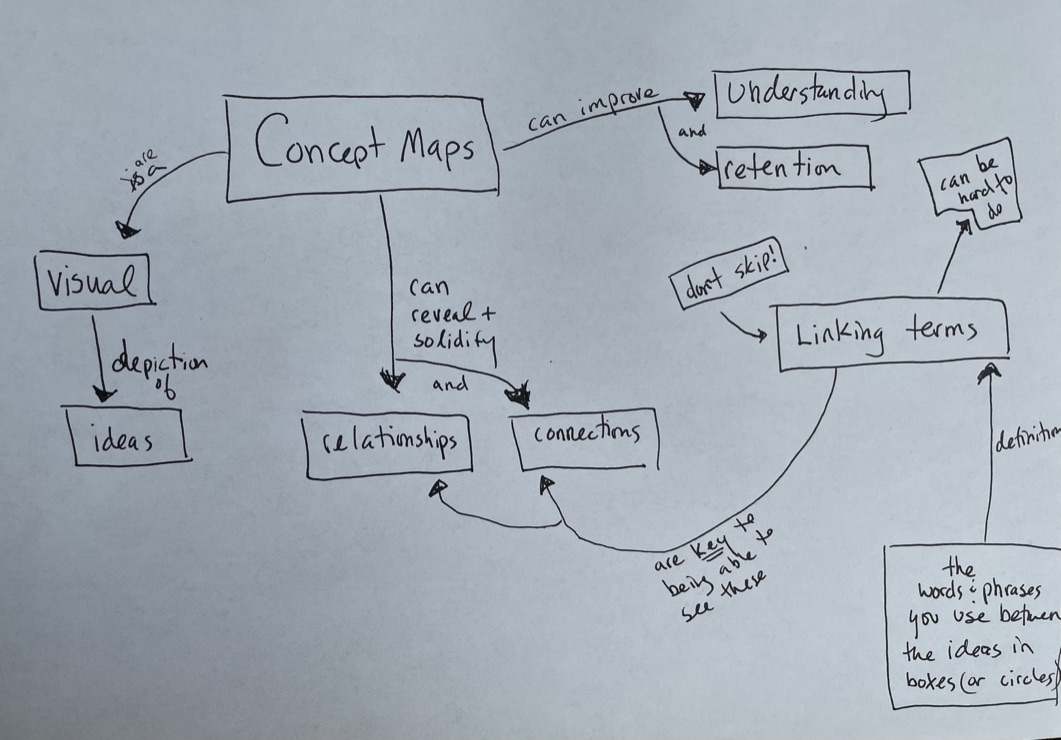
The mapping method, also called concept mapping or mind mapping, uses visual connections to show how ideas relate to one another.
Instead of arranging all information in a linear list, you place a central topic on the page and connect related concepts using branches, arrows, labels, or linking phrases.
For example, a concept map about climate change might connect the central topic to greenhouse gases, global temperatures, ecosystems, energy production, and mitigation strategies.
Digital mapping tools can make it easier to move ideas, add supporting details, and connect concepts from different lectures.
How to create useful digital concept maps
- Write the main topic in the center or at the top.
- Add the major concepts around it.
- Draw connections between related ideas.
- Label connections so their meaning is clear.
- Add examples or evidence where necessary.
- Review the map and remove unnecessary connections.
A useful map should explain relationships, not simply collect keywords. For instance, an arrow labeled “increases the risk of” communicates more than a line connecting two unrelated-looking terms.
Best for: Biology, environmental science, sociology, psychology, systems thinking, and interdisciplinary subjects.
4. The Charting Method: Best for Comparisons and Repeated Categories
The charting method organizes information in rows and columns. Each column represents a category, while each row records information about an item, concept, event, or example.
This is particularly useful when you need to compare several concepts using the same criteria.
For example, a political science student might compare different government systems using these headings:
| System | Leadership | Lawmaking | Key characteristic |
|---|---|---|---|
| Presidential | Elected president | Legislature | Separate executive and legislative branches |
| Parliamentary | Prime minister | Parliament | Executive usually depends on parliamentary confidence |
| Constitutional monarchy | Monarch under constitutional limits | Depends on the country’s system | Monarchical authority is limited by constitutional arrangements |
The exact details will depend on the countries and course material being studied, but the table format makes similarities and differences easier to identify.
Tips for digital chart notes
Choose categories before recording information. Keep each cell concise and use consistent terminology. If a concept requires a lengthy explanation, link to a separate note rather than filling the entire table with paragraphs.
Best for: Economics, comparative politics, anatomy, language learning, research methods, and subjects involving classifications or comparisons.
5. The Zettelkasten Method: Best for Research and Long-Term Learning
The Zettelkasten method uses small, focused notes connected through meaningful links. Instead of keeping all information about a subject in one enormous document, you create separate notes for individual ideas and connect them to related concepts.
This approach can be useful when a student is writing a dissertation, developing a research project, or exploring a topic across several courses.
For example, a student researching online education might create separate notes about student engagement, digital accessibility, assessment design, and learning outcomes. Each note can link to related ideas and identify the sources that support its claims.
How to start a digital Zettelkasten
- Create one note for each important idea.
- Give each note a specific, descriptive title.
- Record the idea in your own words.
- Include source details for facts, quotations, and borrowed arguments.
- Link the note to other relevant concepts.
- Review the connections when planning an essay or research project.
Do not create links merely to make the system look connected. Each link should explain a genuine relationship between ideas.
This method requires more organization than ordinary lecture notes, so it may be unnecessary for a short introductory course. Its value becomes clearer when you accumulate knowledge over months or years.
Best for: Graduate students, dissertation writers, independent researchers, and students managing long-term projects.
6. The Digital Annotation Method: Best for Textbooks and Research Papers
Sometimes the most useful notes belong directly alongside the material you are reading. Digital annotation allows you to highlight selected passages, add comments, ask questions, and record connections to other sources.
Depending on the document and application, you may be able to annotate PDF files, e-books, lecture slides, and academic papers.
A practical annotation workflow
Before reading, identify your purpose. Are you looking for a definition, evidence for an argument, an explanation of a theory, or a response to a research question?
During reading, highlight only the passages that serve that purpose. Add short comments explaining why a passage matters, rather than highlighting it without reflection.
After reading, write a brief summary without looking at the text. Record questions that remain unanswered and note the page numbers or locations of important evidence.
Cornell University’s guidance on digital academic materials recommends learning the available reading and annotation tools while remaining actively engaged with the material. Highlighting alone is not a substitute for understanding.
Best for: Academic journal articles, literature reviews, online textbooks, legal readings, and research-based assignments.
Which Digital Note-Taking Method Should You Choose?
There is no single method that works equally well for every subject. Your choice should depend on the type of information you need to record and how you will use it later.
| Your main goal | Recommended method |
|---|---|
| Review lecture material with questions | Cornell method |
| Organize detailed lectures | Outline method |
| Understand relationships between ideas | Mapping method |
| Compare facts, theories, or categories | Charting method |
| Build a connected research knowledge base | Zettelkasten method |
| Study directly from readings and PDFs | Digital annotation |
You can also combine methods. For example, use Cornell notes during lectures, concept maps for difficult theories, and digital annotations when reading research papers.
Start with one main method for each course. Add another only when it solves a specific problem.
How to Build an Organized Digital Note-Taking System
Even the best note-taking method becomes difficult to use if your files are scattered across devices and applications. A simple organization system can save time throughout the semester.
1. Create a folder for each semester and course
Use a consistent structure such as:
- Semester 1
- Biology
- Lecture notes
- Reading notes
- Revision questions
- Assignments
- Statistics
- Lecture notes
- Worked examples
- Revision questions
- Biology
Adapt the structure to your course requirements. The goal is to make important material easy to locate.
2. Use clear file names
Choose names that tell you what a document contains. For example, use Biology_Week-04_Cell-Division instead of Lecture Notes Final Updated.
Consistent naming makes searching easier and helps prevent duplicate files.
3. Keep notes concise and meaningful
Record main ideas, definitions, evidence, examples, and questions. Use your own words wherever possible. If you copy a quotation or a specific claim from a source, retain enough source information to identify it later.
4. Back up important notes
Use an approved backup method, such as a trusted cloud service or a separate storage location. Check whether your notes are actually syncing, and make sure you can access important files if you lose internet access or change devices.
Review the privacy settings of any service you use, especially when your notes contain research data or restricted course materials.
5. Review and update notes regularly
Set aside a short period after each lecture to correct mistakes, add questions, and summarize the main points. Review those notes again over the following days and weeks.
Spacing out study sessions and testing yourself from memory can support long-term learning more effectively than leaving all revision until the night before an exam. Cornell’s Learning Strategies Center recommends retrieval practice and spaced practice as effective study strategies.
Common Digital Note-Taking Mistakes to Avoid
Digital tools make it easy to collect large amounts of information, but more notes do not automatically mean better learning.
Avoid these common mistakes:
- Typing everything word for word: Select important ideas and explain them in your own language.
- Highlighting too much: Mark only information that serves a clear purpose.
- Using too many applications: Choose a small set of tools you can maintain consistently.
- Creating notes but never reviewing them: Schedule regular revision sessions.
- Ignoring source details: Record citations and page numbers when working with academic materials.
- Overdesigning your notes: Spend more time understanding information than adjusting colors, fonts, and layouts.
- Relying only on search: Knowing where a fact is stored is not the same as being able to explain it from memory.
The purpose of a digital note system is to make learning more manageable, not to create another task that competes with studying.
Frequently Asked Questions
What is the best digital note-taking method for university students?
The Cornell method is a strong starting point for students who want structured lecture notes and built-in review questions. However, the best method depends on the subject: mapping works well for connected ideas, charting helps with comparisons, and digital annotation is useful for academic reading.
Are digital notes better than handwritten notes?
Neither approach is automatically best for every student or task. Digital notes offer search, editing, organization, and multimedia features, while handwriting may suit some students when processing information during a lecture. Choose the approach that helps you understand and remember the material, and consider using both when appropriate.
Which devices are useful for digital note-taking?
A laptop is useful for typing and organizing long documents. A tablet with a stylus can be convenient for handwritten annotations, diagrams, and equations. A smartphone is helpful for quick reminders and reviewing notes, although its smaller screen may be less comfortable for extended study.
How can I remember information from digital notes?
Use your notes to create questions, answer them without looking, and revisit difficult topics over multiple sessions. Summarize concepts in your own words and solve practice problems when relevant. These activities help you test what you know instead of relying only on rereading.
Should I use AI to summarize my lecture notes?
AI may help organize or summarize permitted material, but it can omit important details or introduce errors. Check any summary against your original notes and course materials. Follow your institution’s rules and avoid uploading confidential or restricted information.
Conclusion
The best digital note-taking methods for university students combine organization with active learning. Cornell notes can turn lectures into review questions, outlines can clarify complex topics, concept maps can reveal relationships, charts can simplify comparisons, and linked notes can support long-term research.
You do not need a complicated system to get started. Choose a method that fits your course, organize your notes consistently, and review them regularly. Most importantly, use your notes to explain concepts, test your memory, and identify what you still need to learn.
When digital notes become an active part of your study routine rather than a collection of stored information, they can help you manage coursework more confidently and prepare more effectively for university assessments.