Critical thinking is one of the most useful skills you can develop for your professional life. Whether you are starting your first job, completing an internship, managing a team, or building a career, the ability to analyze information and make informed decisions can help you handle challenges more effectively.
In the workplace, problems rarely come with complete instructions or obvious answers. You may need to investigate why a project is delayed, compare competing recommendations, interpret data, or decide how to respond to a customer’s concern. These situations require more than quick reactions. They require careful reasoning, sound judgment, and a willingness to question assumptions.
Developing critical thinking skills for the workplace does not mean criticizing every idea or overanalyzing every decision. It means understanding a situation, examining the available evidence, considering different perspectives, and choosing a reasonable course of action.
This guide explains what workplace critical thinking involves, why it matters, and how you can strengthen it through practical daily habits.
What Are Critical Thinking Skills for the Workplace?
Critical thinking is the ability to examine information, evaluate evidence, question assumptions, and reach well-reasoned conclusions. In a professional environment, it helps people understand problems, compare possible solutions, and explain why they recommend a particular action.
The London School of Economics and Political Science identifies questioning information, evaluating evidence, and forming defensible judgments as important parts of critical thinking in professional life. These abilities are especially useful when information is incomplete or circumstances are uncertain.
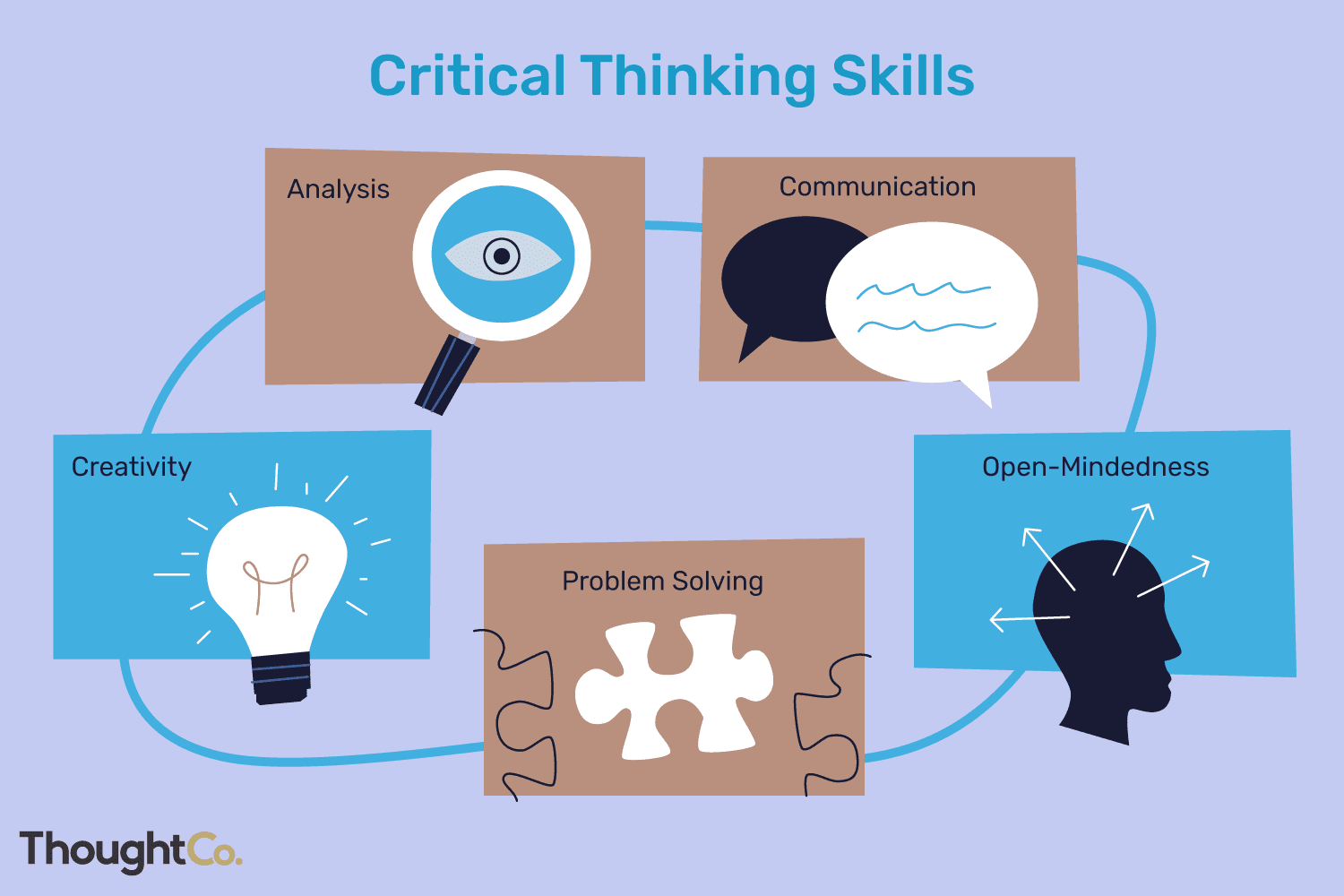
Workplace critical thinking includes several related abilities:
- Analytical thinking: Breaking complex problems into smaller parts.
- Problem-solving: Identifying causes and developing practical solutions.
- Decision-making: Comparing options and selecting an appropriate course of action.
- Information evaluation: Checking whether data and sources are reliable.
- Open-mindedness: Considering perspectives that differ from your own.
- Self-reflection: Recognizing mistakes, assumptions, and gaps in your reasoning.
- Communication: Explaining your conclusions clearly and supporting them with evidence.
These skills are relevant across industries. An accountant may investigate an unexpected financial result, a teacher may evaluate different approaches to a learning challenge, and a project coordinator may identify why a deadline is at risk.
Why Is Critical Thinking Important at Work?
Strong critical thinking helps employees make better-informed decisions instead of relying entirely on habit, guesswork, or the first explanation they encounter.
It is useful in several everyday workplace situations.
Better problem-solving: Employees can investigate the underlying cause of a problem rather than repeatedly addressing its symptoms.
More informed decisions: Comparing evidence and alternatives makes it easier to identify potential benefits, costs, and risks.
Improved communication: People who can explain their reasoning help colleagues understand how a recommendation was developed.
Greater adaptability: Critical thinkers can reconsider their approach when new information changes the situation.
More effective teamwork: Evaluating ideas respectfully allows teams to improve proposals without turning disagreements into personal conflicts.
Professional growth: Reflecting on outcomes helps employees recognize what works, learn from mistakes, and make better decisions in future situations.
Critical thinking is particularly valuable when a task has no single obvious solution. Rather than pretending to have complete certainty, a thoughtful employee identifies what is known, what remains unclear, and what evidence would help resolve the issue.
1. Ask Better Questions Before Making Decisions
One of the simplest ways to improve critical thinking is to pause before accepting a claim or jumping to a conclusion.
When a problem arises, ask questions that help you understand the situation.
- What exactly is the problem?
- What outcome are we trying to achieve?
- What evidence supports the current explanation?
- What information is missing?
- Are there other possible causes?
- What constraints must we consider?
For example, suppose a team notices that customer complaints have increased. A quick reaction might be to blame the support team. A more thoughtful approach would investigate complaint categories, response times, recent product changes, and customer feedback.
The increase might be related to a product issue, confusing instructions, delayed deliveries, or a change in how complaints are recorded.
Better questions prevent you from solving the wrong problem. They also show colleagues that you want to understand the situation before recommending a solution.
2. Learn to Evaluate Information and Evidence
Workplace decisions often depend on reports, spreadsheets, research, customer feedback, and advice from colleagues. However, not all information is equally reliable or relevant.
Before using information to support a decision, consider its source, accuracy, age, and limitations.
Ask yourself whether the information comes from a credible source, whether it reflects the current situation, and whether important details have been left out.
For example, a manager might receive a report suggesting that a marketing campaign increased sales. Before concluding that the campaign caused the increase, the team should examine the timing, compare sales with an appropriate baseline, and consider other possible influences.
Useful habits include:
- Compare information from more than one credible source.
- Check dates, definitions, and measurement methods.
- Distinguish observed facts from opinions or interpretations.
- Look for missing data and possible sources of bias.
- Verify important calculations before using them.
- Acknowledge uncertainty when the evidence is incomplete.
These habits help you build recommendations that are based on evidence rather than confidence alone.
3. Identify the Root Cause of Problems
A common workplace mistake is addressing a visible symptom without investigating why it occurred.
Imagine that a team repeatedly submits reports late. Reminding employees about deadlines might help temporarily, but it may not solve the underlying issue.
The actual cause could be unclear responsibilities, unrealistic schedules, missing information, or a process that requires unnecessary approvals.
To investigate a problem, begin by describing what is happening in specific terms. Then collect relevant information, identify possible causes, and test which explanation best fits the evidence.
You can use a simple root-cause process:
- Define the problem clearly.
- Gather facts about when and where it occurs.
- Identify possible contributing factors.
- Check which factors are supported by evidence.
- Choose an appropriate corrective action.
- Review the results to see whether the problem improves.
Avoid assuming that the first plausible explanation must be correct. If the problem continues after a change, revisit your assumptions and investigate further.
4. Consider Multiple Perspectives
Your first interpretation of a situation may not be the only reasonable one. Colleagues in different roles often notice different risks, needs, and opportunities.
For example, a proposal to introduce new software might appear efficient to a manager but create accessibility, training, or compatibility challenges for employees. Considering these perspectives can lead to a more practical decision.
Before recommending an action, ask how it might affect customers, coworkers, managers, and other relevant stakeholders.
You can strengthen this habit by:
- Listening to colleagues before defending your own view.
- Asking people with relevant experience for their input.
- Separating disagreement about an idea from judgment about a person.
- Looking for evidence that challenges your initial opinion.
- Considering both short-term effects and longer-term consequences.
Being open-minded does not mean treating every opinion as equally accurate. It means giving relevant perspectives a fair hearing and evaluating them carefully.
5. Compare Solutions Before Choosing One
Once you understand a problem, avoid settling automatically on the first possible solution. Generate alternatives and compare them against clear criteria.
Useful criteria may include cost, time, effectiveness, feasibility, risk, and impact on people.
Consider a small team that needs to reduce time spent preparing weekly reports. Possible options might include simplifying the report template, automating repetitive calculations, or changing how information is collected.
Each option has different benefits and limitations. Automation may save time in the long run but require initial setup, while simplifying the template may be quicker but offer smaller savings.
A practical decision process is to:
- List two or three realistic alternatives.
- Identify the advantages and disadvantages of each.
- Consider the resources and risks involved.
- Choose the option that best fits the goal and constraints.
- Define how you will evaluate the result.
For significant decisions, document the reasons for your choice. This makes it easier to explain your recommendation and reconsider it if new information becomes available.
6. Recognize Biases and Challenge Your Assumptions
Everyone has assumptions that influence how they interpret information. Critical thinking improves when you learn to recognize these assumptions and examine whether they are justified.
For example, you might believe that an experienced colleague is always correct, or that a new process will fail because an earlier attempt did not work.
These beliefs may influence your decisions even when the current evidence points in another direction.
To challenge your assumptions, ask:
- Am I relying on facts or personal impressions?
- Would I interpret this information differently if someone else presented it?
- Am I ignoring evidence because it conflicts with what I already believe?
- What information would change my mind?
- Have I confused a familiar approach with the best approach?
One useful technique is to write down your initial conclusion and the evidence supporting it. Then deliberately identify the strongest reasonable argument against that conclusion.
This exercise does not require you to abandon your position. It helps you determine whether your reasoning remains convincing after considering alternatives.
7. Strengthen Your Critical Thinking Through Teamwork
Critical thinking is not limited to individual analysis. Teams can improve their decisions by sharing information, questioning ideas constructively, and examining problems from different angles.
During meetings, contribute thoughtful questions instead of agreeing automatically. If a proposal has a weakness, explain the concern and suggest how it might be addressed.
For example, you could say, “The proposed timeline looks achievable if we receive the data by Monday. What should we do if the data arrives later?”
This approach identifies a potential risk without dismissing the proposal.
You can also help teams distinguish between brainstorming and decision-making. During brainstorming, encourage a range of ideas. When it is time to choose a solution, evaluate those ideas against agreed criteria.
Respectful disagreement is useful when it improves the quality of the discussion. The goal is not to win an argument; it is to reach a better-informed decision.
8. Use Data and Technology Thoughtfully
Digital tools can help employees organize information, identify patterns, and compare alternatives. Spreadsheets, dashboards, research databases, and AI tools may support critical thinking when used appropriately.
However, a tool’s output should not automatically be treated as correct.
When reviewing a chart or report, check what the data measures, whether the sample is representative, and whether the conclusion follows from the evidence. A correlation between two variables, for instance, does not by itself prove that one caused the other.
When using AI tools, verify important claims against reliable sources, review calculations, and consider whether relevant context is missing. Avoid sharing confidential company information with tools unless their use has been approved and their data-handling policies are suitable.
Technology can help you process information more efficiently, but professional judgment is still needed to interpret results and decide what action makes sense.
9. Learn From Feedback and Mistakes
Critical thinking develops through practice, and reflection is an important part of that process.
After completing a project or making a decision, take a few minutes to review what happened. Consider which assumptions were correct, which information proved useful, and what you would do differently next time.
If a recommendation does not produce the expected result, investigate why rather than immediately blaming someone or abandoning the approach without analysis.
Ask your supervisor or colleagues for specific feedback. For example, you might ask whether your analysis was clear, whether you considered the most important risks, or whether your recommendation needed stronger evidence.
Keep a short record of challenging decisions and what you learned from them. Over time, these notes can reveal recurring patterns in your reasoning and help you improve your judgment.
A Simple Daily Exercise to Build Critical Thinking Skills
You can develop critical thinking without waiting for a major workplace problem. Try this short exercise using a decision or challenge from your daily routine.
Step 1: Define the situation. Write one or two sentences describing the problem without adding assumptions about its cause.
Step 2: Separate facts from interpretations. List what you know, what you believe, and what remains uncertain.
Step 3: Generate alternatives. Identify at least two possible explanations or solutions.
Step 4: Evaluate the evidence. Consider which information supports each option and what additional information might be needed.
Step 5: Make a reasoned decision. Choose an action and explain why it is appropriate given the available evidence.
Step 6: Review the outcome. Check whether the action worked and what the experience taught you.
Practicing this process for a few minutes several times a week can help make thoughtful analysis a more natural habit.
Frequently Asked Questions
What are examples of critical thinking skills in the workplace?
Examples include analyzing a report, identifying the cause of a recurring problem, comparing solutions, questioning unsupported assumptions, evaluating risks, and explaining a recommendation with evidence.
Can critical thinking skills be learned?
Yes. People can strengthen these skills through practice, research, feedback, problem-solving exercises, and reflection. Progress comes from regularly examining how you reach conclusions rather than relying only on instinct.
How can I demonstrate critical thinking in a job interview?
Describe a specific situation in which you faced a problem, evaluated information, considered alternatives, and took action. Explain your reasoning and the outcome. Academic projects, internships, volunteering, and part-time jobs can all provide relevant examples.
Is critical thinking the same as problem-solving?
They are closely related but not identical. Critical thinking involves evaluating information and reasoning carefully, while problem-solving focuses on finding and implementing a solution. Strong problem-solving often depends on critical thinking.
How can managers encourage critical thinking in their teams?
Managers can invite questions, encourage employees to explain their reasoning, consider different viewpoints, provide useful feedback, and create an environment where people can raise concerns respectfully. Teams should also have clear goals and access to the information needed for sound decisions.
Conclusion
Building critical thinking skills for the workplace is an ongoing process. It requires curiosity, careful evaluation of evidence, willingness to consider alternative explanations, and the ability to learn from experience.
Start by asking better questions, checking the quality of information, investigating root causes, and comparing possible solutions before making important decisions. Practice explaining your reasoning and remain open to feedback when new evidence challenges your conclusions.
These habits can help you solve problems more effectively, contribute to stronger team decisions, and approach professional challenges with greater confidence and sound judgment.
Leave a Reply