Creating a resume can feel difficult when you have never held a formal job. You may be applying for your first internship, a part-time position, an entry-level role, or an opportunity related to your university studies. Without a traditional employment history, it can be challenging to decide what information to include and how to demonstrate your value to an employer.
The good news is that skills based resume with no work experience can help you highlight what you can do rather than focus on jobs you have not yet held. Your education, academic projects, volunteering, extracurricular activities, personal projects, and relevant training can all provide evidence of your abilities.
The key is to connect your skills to real examples. Instead of simply claiming that you are organized, creative, or good at communication, show how you have demonstrated those qualities through your activities and achievements.
This guide explains how to create a professional resume from scratch, choose the right skills, write stronger bullet points, and present your qualifications honestly.
What Is a Skills-Based Resume?
A skills-based resume emphasizes relevant abilities and qualifications rather than making employment history the main focus. It can be particularly useful for university students, recent graduates, career changers, and applicants entering the workforce for the first time.
A traditional resume often gives significant space to previous jobs. A skills-based approach places more emphasis on what you have learned, what you can do, and how you have applied those abilities.
For example, a student applying for a marketing internship may not have professional marketing experience. However, they might have created social media content for a university club, researched audiences for a class project, or designed promotional materials for a campus event.
These activities can demonstrate relevant skills when described accurately.
A skills-based resume is not a way to hide missing experience or exaggerate qualifications. It is a way to present your most relevant evidence in a format that makes sense for the position you want.
1. Study the Job Description Before Writing
Before creating your resume, read the job advertisement carefully. This helps you understand what the employer needs and which of your existing skills deserve the most attention.
Look for three main things:
- Required skills: Abilities explicitly requested, such as writing, spreadsheet use, customer service, or research.
- Responsibilities: Tasks you may be expected to perform.
- Qualifications: Education, certifications, technical knowledge, or other requirements.
Make a list of the most relevant requirements and compare them with your own experience.
For example, if an internship asks for communication, organization, and basic data analysis, you might identify a university group project where you coordinated tasks, prepared a presentation, and analyzed survey results.
Use relevant terminology from the job description when it accurately describes your abilities. This can make your resume easier for recruiters to evaluate and may help automated screening systems identify relevant qualifications.
However, do not include skills simply because they appear in the advertisement. You should be able to explain or demonstrate every skill you list.
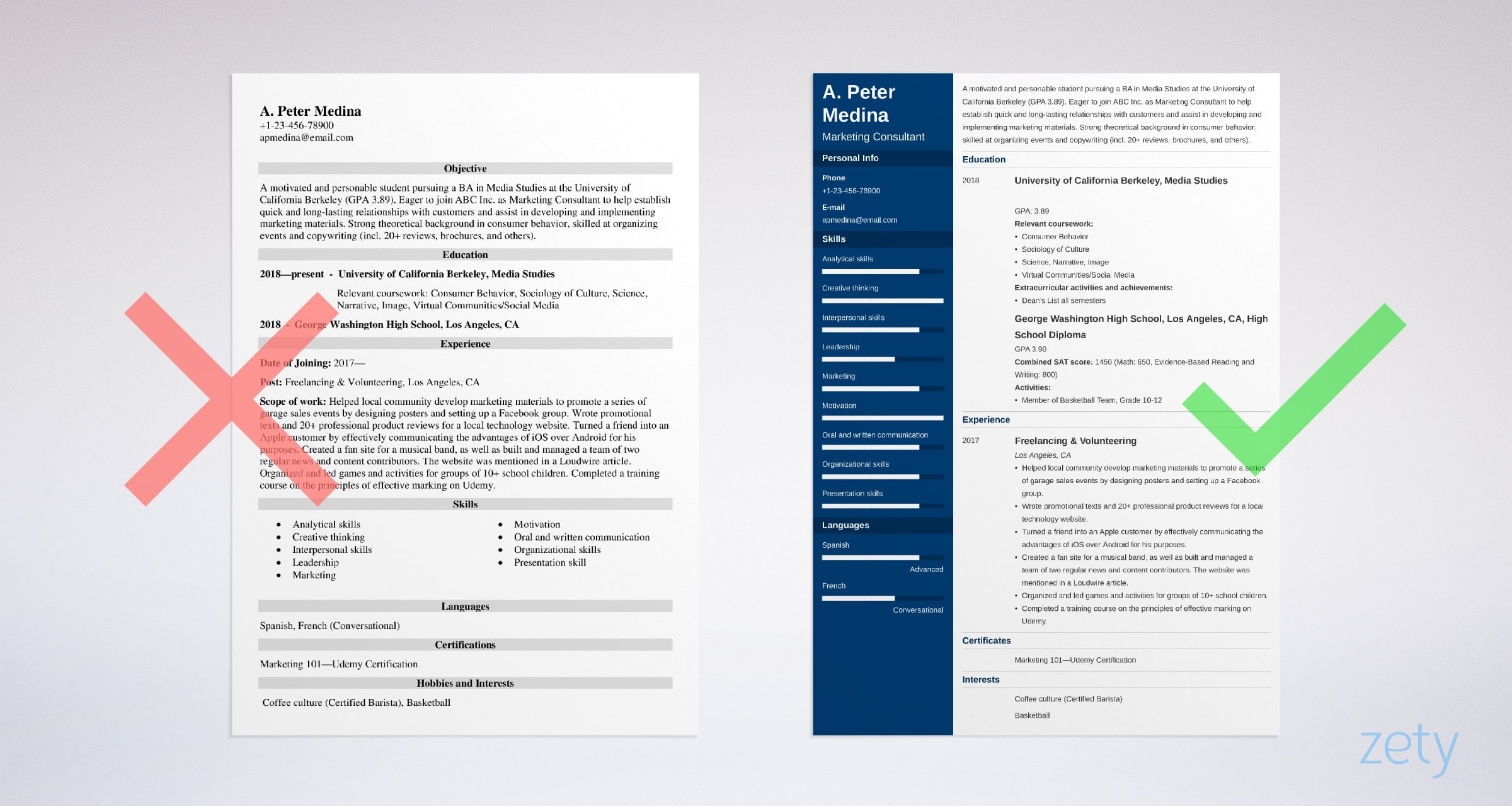
2. Choose a Simple, Professional Resume Format
Your resume should make important information easy to find. For most students and recent graduates, a clean, one-page document is a practical starting point.
Use clear headings, consistent spacing, readable fonts, and bullet points. Avoid complicated graphics, decorative tables, and unnecessary design elements that may distract from your qualifications or interfere with automated resume processing.
A useful structure is:
- Name and contact information
- Professional summary or career objective
- Education
- Relevant skills
- Academic projects and practical experience
- Volunteering, leadership, or extracurricular activities
- Certifications and additional information, if relevant
You can adjust this order based on your strongest qualifications and the job requirements.
For example, a student with a relevant degree and impressive academic projects may place education and projects near the top. Someone with a useful technical certification may choose to feature skills or certifications earlier.
The goal is not to follow one rigid template. It is to make your most relevant qualifications immediately visible.
3. Write a Strong Resume Summary
A resume summary is a short introduction that explains your current background, relevant strengths, and career direction. For applicants without formal employment history, it can help employers understand what you offer.
Keep it specific and concise. Avoid generic statements such as “I am hardworking and looking for a challenging opportunity.”
Instead, identify your education, relevant skills, and the type of opportunity you are seeking.
Example for a university student:
“Business student with experience in academic research, spreadsheet analysis, and team presentations. Interested in applying organizational and analytical skills in an entry-level business or administrative role.”
Example for a computer science student:
“Computer science student with foundational knowledge of Python, HTML, and database concepts. Developed academic projects involving problem-solving, testing, and technical documentation. Seeking an opportunity to build practical software development skills.”
Use these examples as models rather than copying claims that do not describe your background. If you have limited experience, you can focus on your studies, current skills, and willingness to develop professionally.
4. Highlight Skills You Can Actually Demonstrate
One of the most important steps in building a skills-based resume with no work experience is identifying abilities you have developed through study and everyday activities.
Skills generally fall into two broad categories.
Technical skills are specific abilities that can often be learned or assessed through practice. Examples include spreadsheet formulas, programming, graphic design, research methods, writing, and using relevant software.
Transferable skills can be applied across different roles and industries. Examples include communication, teamwork, problem-solving, organization, adaptability, and critical thinking.
The most appropriate skills depend on the position you are applying for.
| Target role | Relevant skills to consider |
|---|---|
| Administrative assistant | Document formatting, organization, scheduling, spreadsheets |
| Marketing intern | Content creation, research, writing, basic analytics |
| Research assistant | Information evaluation, data organization, academic writing |
| Customer service trainee | Communication, active listening, problem-solving |
| Junior developer | Programming languages, debugging, version control, testing |
Only include skills you genuinely possess. If you are still learning a tool, describe your level accurately rather than presenting yourself as an expert.
Where possible, demonstrate transferable skills in your project descriptions instead of relying on a long list of adjectives.
5. Turn Academic Projects Into Resume Experience
Academic projects are valuable because they show how you apply knowledge to a practical task. They can be especially useful when you have no paid employment history.
Choose projects that relate to the role you want. Include the project title, the context, the actions you took, and the skills you used.
For example, a vague description might say:
“Completed a university research project.”
A stronger description would be:
“Researched student study habits, organized survey responses in a spreadsheet, and summarized key findings in a written report and class presentation.”
The second example gives an employer a clearer picture of your abilities.
You can include individual assignments, group projects, research papers, coding projects, design portfolios, or independent work, provided the details are relevant and accurate.
When writing bullet points, use this simple formula:
Action verb + task + method or purpose + result, when available.
Examples include:
- Analyzed survey responses to identify patterns in student preferences.
- Coordinated responsibilities among four group members to complete a class presentation by the deadline.
- Designed a prototype website to demonstrate basic HTML and CSS skills.
- Prepared a research summary by comparing information from credible academic sources.
Include numbers when they are meaningful and verifiable. Never invent results to make a project appear more impressive.
6. Include Volunteering, Clubs, and Personal Projects
You do not need a paid job to develop useful experience. University societies, community service, student events, independent projects, and extracurricular activities can all provide evidence of relevant skills.
Think about what you actually did in these activities.
If you helped organize a student event, you might have coordinated schedules, communicated with participants, or managed registrations. If you volunteered at a community organization, you might have helped maintain records, explain information to visitors, or organize supplies.
Describe the contribution rather than simply listing the activity.
For example:
Student Society — Event Volunteer
- Assisted with event registration and participant communication.
- Coordinated with team members to prepare materials before the event.
- Helped resolve routine logistical issues during the program.
Only use bullet points that reflect your real responsibilities.
Personal projects can also be valuable. A portfolio website, a small data-analysis project, a writing sample, or a design collection can demonstrate initiative and practical ability. Include a link to your work if it is relevant, professional, and ready to share.
7. Write a Skills Section That Supports Your Evidence
A dedicated skills section makes relevant qualifications easy to identify. However, listing too many unrelated abilities can weaken your resume.
Group skills into clear categories when appropriate.
Technical skills: Microsoft Excel, Google Sheets, Python, Canva, or another tool you genuinely know.
Research and analysis: Literature searches, survey analysis, data organization, or report preparation.
Languages: List languages and describe your proficiency accurately.
Professional skills: Communication, teamwork, time management, and problem-solving are often more convincing when demonstrated in project or volunteer descriptions.
Avoid rating yourself as “excellent” at everything. Employers may ask questions or conduct practical assessments to verify your skills.
Your resume should present a consistent picture: the skills listed in the skills section should be supported by your education, projects, activities, or other relevant evidence whenever possible.
8. Optimize Your Resume for Recruiters and Screening Systems
Some employers use applicant tracking systems to organize applications and identify qualifications relevant to a job. A readable, clearly structured resume can help both software and human reviewers understand your background.
Follow these practical guidelines:
- Use standard headings such as Education, Skills, Projects, and Volunteer Experience.
- Include relevant keywords from the job description naturally.
- Use common fonts and consistent formatting.
- Avoid hiding important information in images or decorative graphics.
- Use descriptive bullet points rather than long paragraphs.
- Proofread the document for spelling, grammar, and formatting errors.
- Follow the employer’s requested file format and application instructions.
Save your final file with a professional filename, such as FirstName_LastName_Resume.pdf, unless the employer requests a different format.
There is no universal resume format that guarantees an applicant will pass every screening system. The most important approach is to follow the employer’s instructions and make your qualifications clear, relevant, and truthful.
9. Review and Tailor Your Resume for Every Application
Before submitting your resume, compare it with the job advertisement one more time.
Ask yourself:
- Are my most relevant skills easy to find?
- Have I included projects or activities that demonstrate those skills?
- Do my bullet points explain what I actually contributed?
- Have I removed unrelated details that take up space?
- Are all dates, qualifications, and claims accurate?
- Is my contact information correct?
- Does the document look professional on the page?
Tailoring does not mean rewriting your resume from scratch for every application. Often, you can change the order of sections, refine a few bullet points, or highlight different projects to better match the role.
Ask a university career adviser, mentor, or trusted reviewer for feedback if possible. A second reader may notice unclear wording or mistakes you missed.
Frequently Asked Questions
Can I create a resume if I have never had a job?
Yes. You can use your education, academic projects, volunteering, extracurricular activities, certifications, and personal projects to demonstrate relevant skills. Focus on what you have done and learned rather than apologizing for a lack of employment history.
What should I put on a resume with no work experience?
Include contact information, a concise summary if useful, education, relevant skills, academic projects, volunteering, leadership activities, and certifications. Prioritize sections that best match the job requirements.
Should I include soft skills on a skills-based resume?
Yes, but support them with examples. Instead of only listing teamwork, describe a group project where you coordinated responsibilities or helped resolve a disagreement.
How long should a resume be if I have no work experience?
For most students and recent graduates, one page is usually sufficient. Use the space to present relevant qualifications clearly rather than adding unrelated details to fill the page.
Can I use AI to help write my resume?
AI can help organize information, improve clarity, and suggest stronger bullet points. However, verify every statement, remove inaccurate claims, and make sure you can explain your skills and accomplishments in an interview.
Conclusion
Creating a skills-based resume with no work experience is an opportunity to show employers what you can contribute, even if you have not held a formal job yet.
Start by understanding the position, choosing a clear format, and identifying the skills most relevant to the role. Then use academic projects, volunteering, extracurricular activities, and personal work to demonstrate those abilities with specific examples.
Keep your resume concise, truthful, and easy to read. Tailor it to each application, proofread it carefully, and continue building your skills through practical projects and learning opportunities.
Your first resume does not need an impressive employment history. It needs a clear, credible explanation of what you know, what you can do, and how you are prepared to grow.
Leave a Reply