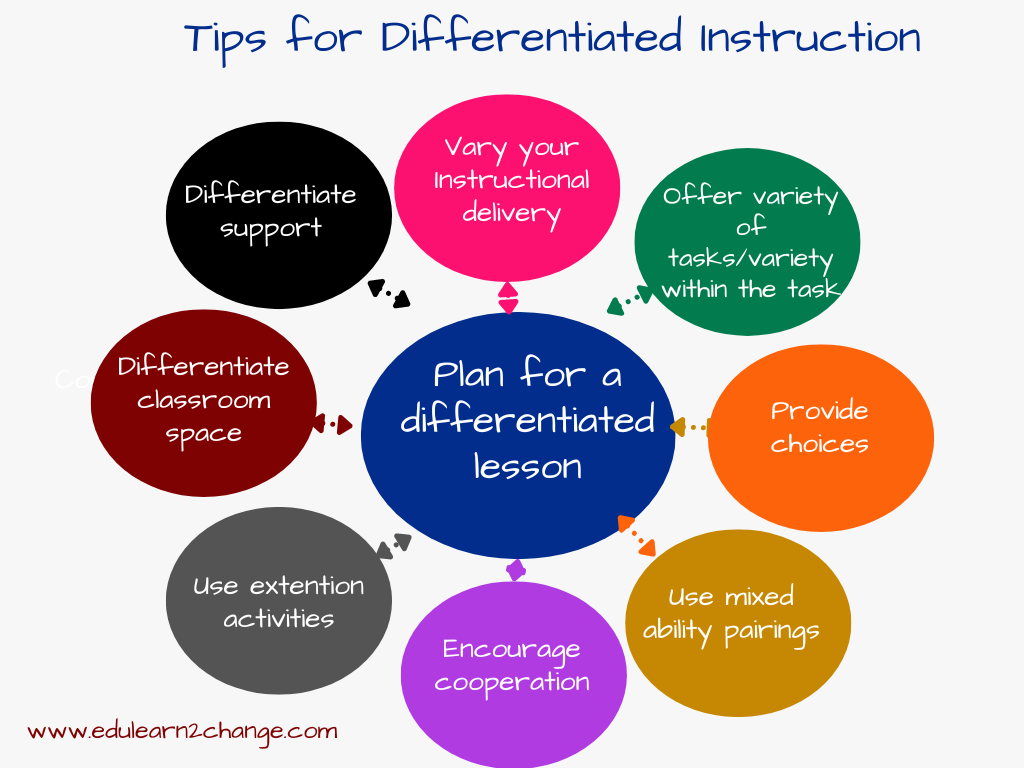
Every classroom includes students with different strengths, interests, backgrounds, and levels of readiness. Some students understand a new concept quickly, while others need additional explanations, guided practice, or more time. Some thrive when solving problems independently, while others benefit from discussion, visual examples, or hands-on activities.
Differentiated instruction helps teachers respond to these differences while keeping students focused on meaningful learning goals. Rather than expecting every student to learn through the same activity in exactly the same way, teachers adjust instructional methods, resources, support, and assessment options to help more learners succeed.
For educators looking for differentiated instruction examples for teachers, the good news is that differentiation does not require writing a separate lesson plan for every student. Small, intentional adjustments can make a lesson more accessible, engaging, and appropriately challenging.
This guide explains what differentiated instruction means, how it works, and how teachers can apply practical strategies in different subjects and grade levels.
What Is Differentiated Instruction?
Differentiated instruction is an approach to teaching that adapts learning experiences to students’ readiness, interests, and learning needs. Teachers use information from assessments, classroom observations, student work, and conversations to decide which supports or challenges will help learners move forward.
The learning objective can remain consistent even when students use different materials, activities, or ways of demonstrating their understanding.
For example, a class might be learning to identify the main idea of an informational text. Some students may work with a shorter passage and a graphic organizer, while others analyze a longer text and explain how supporting details develop the main idea. Both groups work toward the same essential skill, but the level of support and complexity differs.
The purpose is not to make learning easier for some students and harder for others without a reason. It is to provide an appropriate path toward clear learning goals.
The Four Main Elements of Differentiated Instruction
Teachers can differentiate instruction in four main areas: content, process, product, and learning environment.
1. Content: What students learn
Content refers to the information, concepts, and skills students need to understand. Teachers may adapt the materials or resources used to teach a topic while maintaining the central learning objective.
Examples include:
- Providing texts at different reading-complexity levels that cover the same concept.
- Pre-teaching essential vocabulary before introducing a difficult reading.
- Offering diagrams, demonstrations, or worked examples alongside written explanations.
- Providing more advanced readings or additional concepts to students who have already mastered the basics.
2. Process: How students learn
Process refers to the activities students complete to understand and practice new material.
Teachers might use guided practice, independent work, small-group instruction, learning stations, peer discussion, or hands-on activities. The best choice depends on the learning objective and the evidence of what students need.
For example, students learning fractions might use physical fraction pieces, draw visual models, or solve numerical problems. These activities provide different routes to understanding the same mathematical concept.
3. Product: How students demonstrate learning
Product refers to the work students produce to demonstrate their knowledge or skills.
Depending on the objective, teachers might allow students to create a written explanation, deliver an oral presentation, develop a labeled diagram, or complete a structured problem-solving task.
Different formats should still measure the intended learning goal. If the objective is to evaluate evidence in an argument, every option must give students a meaningful opportunity to demonstrate that skill.
4. Learning environment: Where and under what conditions learning happens
The learning environment includes classroom organization, routines, available resources, and the conditions that help students participate.
Examples include quiet work areas, clearly displayed instructions, predictable lesson routines, accessible materials, and opportunities for individual or collaborative work.
A supportive environment can reduce unnecessary barriers and help students focus on the task.
8 Practical Differentiated Instruction Examples for Teachers
The following strategies can be adapted to elementary, middle, and secondary classrooms. Choose the approaches that best match your students, subject, and available resources.
Example 1: Use flexible reading groups
Best for: Language arts, social studies, and science.
When students read at different levels of proficiency, one text and one set of questions may not provide the right balance of challenge and support for everyone.
A teacher can prepare several texts on the same topic with appropriate differences in vocabulary, length, or complexity. Students then work with a suitable text and answer questions connected to the same central learning objective.
For example, during a unit on ecosystems, one group might read a supported text with a glossary, another might analyze a grade-level article, and a third might compare two sources discussing ecosystem changes.
How to implement it: Use reading responses, short assessments, and classroom observations to identify current needs. Change groups as students develop rather than assigning permanent labels based on perceived ability.
Example 2: Create tiered assignments
Best for: Mathematics, science, and problem-solving lessons.
Tiered assignments allow students to work on the same essential skill with different levels of complexity or support.
In a lesson on fractions, one group might identify equivalent fractions using visual models. Another might solve comparison problems, while students ready for an additional challenge explain their reasoning in unfamiliar situations.
Each task should require meaningful thinking. Students who need support should still work toward the core objective, while students who have mastered the basics should receive greater depth or complexity—not simply a larger quantity of repetitive questions.
How to implement it: Identify the key skill, prepare two or three task versions, and establish clear criteria for success. Use student work to decide when to provide more support or increase the challenge.
Example 3: Use learning stations
Best for: Elementary classrooms and lessons involving several skills.
Learning stations divide a lesson into activities that students complete individually or in small groups. Stations can offer different ways to practice a concept while allowing the teacher to provide targeted support.
For a science lesson about plants, stations might include:
- Observation station: Examine a plant or photographs and identify its parts.
- Reading station: Read a short explanation of plant functions.
- Vocabulary station: Match terms such as roots, stems, and leaves with their definitions.
- Teacher-guided station: Discuss plant needs and address common misunderstandings.
Students rotate through the stations according to a clear schedule.
How to implement it: Keep instructions visible, prepare materials before class, and give every station a specific purpose. If time or space is limited, begin with two stations instead of creating a complicated rotation.
Example 4: Offer different ways to demonstrate understanding
Best for: Projects, literature, history, and interdisciplinary learning.
Some learning objectives can be demonstrated through more than one format. Providing appropriate options gives students flexibility without removing academic expectations.
For a history unit, students might write an evidence-based explanation, deliver a short presentation, or create an annotated timeline with a written analysis.
The teacher uses the same rubric to assess the relevant historical understanding, accuracy, and use of evidence.
How to implement it: Start by defining exactly what students must demonstrate. Offer two or three suitable formats and provide clear instructions and assessment criteria for each.
Avoid offering unrestricted choices when a particular skill—such as formal writing or oral communication—is itself the learning objective being assessed.
Example 5: Provide scaffolds and gradually remove them
Best for: Writing, mathematics, and complex academic tasks.
Scaffolding gives students temporary support as they learn a new skill. Examples include sentence starters, worked examples, graphic organizers, checklists, and step-by-step instructions.
During an essay-writing unit, some students may use a paragraph organizer that identifies the claim, evidence, explanation, and conclusion. Other students may begin drafting independently and use a revision checklist afterward.
As students become more confident, the teacher can reduce the support so learners develop greater independence.
How to implement it: Identify where students are getting stuck, provide a targeted scaffold, and check whether it helps. Avoid giving students so much guidance that they no longer need to think through the task themselves.
Example 6: Use flexible grouping and peer learning
Best for: Discussion, problem-solving, and collaborative projects.
Flexible grouping means organizing students differently according to the task or current learning need. Sometimes students work independently, sometimes in mixed groups, and sometimes with classmates who need similar instruction.
For a mathematics lesson, the teacher might briefly work with a small group that needs additional practice while other students solve problems independently or compare solutions in pairs.
During another lesson, mixed groups could investigate a shared question and explain their conclusions.
How to implement it: Establish clear group roles and expectations. Rotate groups regularly, monitor participation, and make sure each student remains responsible for learning the essential content.
Example 7: Use quick formative assessments
Best for: Any subject or grade level.
Formative assessment helps teachers identify what students understand before moving to the next step. It can be as simple as an exit ticket, a short quiz, a written explanation, or a few questions during a lesson.
After teaching a science concept, a teacher might ask students to explain it in two sentences or interpret a diagram. The responses reveal whether the class is ready to move forward or whether certain misunderstandings need attention.
How to implement it: Ask focused questions linked to the learning objective. Review the results and adjust the next lesson, provide targeted feedback, or offer additional practice where needed.
Example 8: Add extension activities for students ready for more challenge
Best for: Students who demonstrate early mastery of a topic.
Differentiation should support advanced learners as well as students who need more guidance. When students already understand the core concept, extension activities can deepen their thinking.
For example, students who quickly master basic data interpretation might compare two data sets, identify limitations in a graph, or explain how different choices affect the conclusion.
How to implement it: Prepare extension tasks that involve application, analysis, or deeper reasoning. Use evidence of mastery to offer the challenge, rather than assuming that a student who finishes first has understood everything.
How to Plan a Differentiated Lesson Step by Step
Differentiation becomes more manageable when teachers follow a consistent planning process.
- Define the learning objective. Decide what students should know or be able to do by the end of the lesson.
- Check students’ starting points. Use a short pre-assessment, previous work, questioning, or observation to identify current understanding.
- Identify likely barriers. Consider unfamiliar vocabulary, missing background knowledge, task complexity, accessibility, and the level of independence required.
- Choose one area to differentiate. Adjust the content, process, product, or learning environment. You do not need to change every element in every lesson.
- Prepare appropriate support and challenge. Use scaffolds for students who need them and extension activities for students ready to progress.
- Check understanding during the lesson. Use questioning, observation, or a quick assessment to determine whether the approach is working.
- Reflect and adjust. Use student responses to decide what to reteach, extend, or change next time.
This cycle makes differentiated instruction responsive rather than a fixed arrangement of groups and activities.
Common Differentiated Instruction Mistakes to Avoid
Creating a separate lesson for every student. This is usually unnecessary and difficult to maintain. Begin with a shared learning objective and make targeted adjustments where they are useful.
Confusing differentiation with lowering expectations. Students can receive different levels of support while still working toward meaningful learning goals.
Grouping students permanently by ability. Fixed labels can restrict opportunities and may not reflect students’ changing needs. Use flexible grouping informed by current evidence.
Giving advanced students more of the same work. Extension should deepen understanding or introduce worthwhile complexity, not simply increase the number of repetitive exercises.
Offering choices without clear criteria. Different activities and products need transparent instructions and assessment standards aligned with the learning objective.
Making changes without checking their impact. A strategy is not automatically effective just because it looks engaging. Observe participation, review student work, and adjust based on evidence.
Frequently Asked Questions
What is the main goal of differentiated instruction?
The goal is to help students access meaningful learning and progress toward clear objectives by adapting instruction to their readiness, interests, and needs.
Is differentiated instruction suitable for all students?
Yes. It can provide additional support for students who are struggling, appropriate challenges for advanced learners, and different opportunities for engagement across a classroom. The specific adjustments should be based on student needs and the learning objective.
Does differentiated instruction require technology?
No. Teachers can differentiate with printed texts, manipulatives, small-group discussions, graphic organizers, and formative assessments. Digital tools may help organize materials or provide accessible formats, but they are not essential.
How can teachers differentiate instruction in a large class?
Start small. Use brief formative assessments, clear task instructions, flexible grouping, reusable scaffolds, and a limited number of task variations. You can differentiate one part of a lesson without redesigning the entire class.
Final Thoughts
Differentiated instruction helps teachers respond thoughtfully to the range of learners in their classrooms. By adapting content, learning activities, assessment options, and classroom conditions, educators can create more flexible routes toward shared learning goals.
The most effective starting point is simple: identify what students need to learn, find out what they already understand, and make one purposeful adjustment. Try a tiered assignment, a flexible reading group, a quick formative assessment, or an extension task. Then use student work and feedback to decide what to do next.
Over time, these small, evidence-informed changes can become part of a practical teaching routine that supports participation, growth, and appropriately challenging learning for more students.
Leave a Reply